The map and the explanation belong together
The geographic lookup leads to readable context about the geological unit and its relevance to foundation movement, giving a homeowner more than a pin on a map.

“Straight answers on foundation repair — from an engineer, not a call center.”
Understand the ground beneath your home
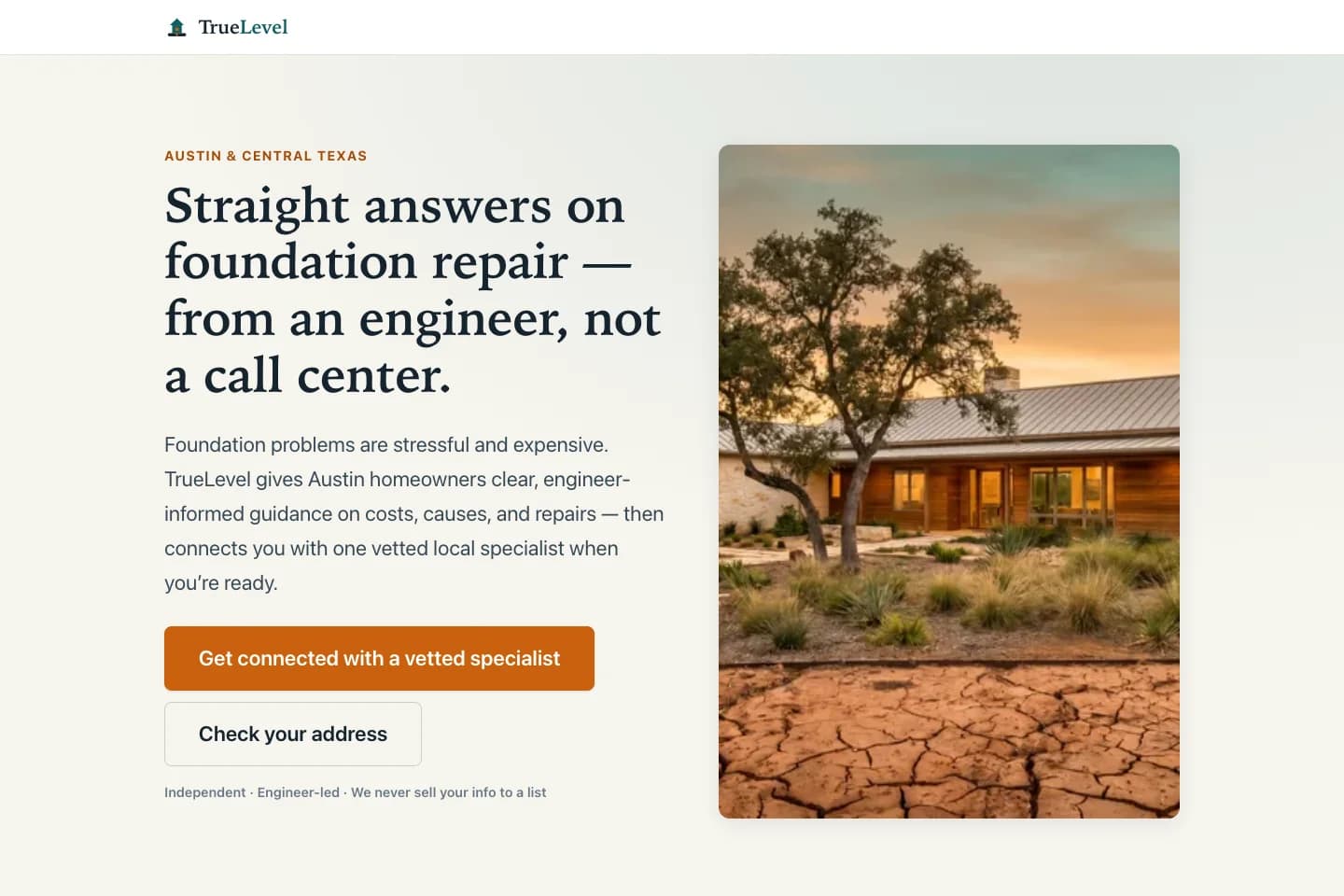
TrueLevel helps Central Texas homeowners understand foundation movement before choosing a next step. Its content connects repair questions to local geology, while an address lookup turns public geographic data into an accessible explanation of the ground beneath a property. The site brings educational content, interactive tools, and a specialist referral flow together.
Foundation movement is difficult for a homeowner to assess. Surface symptoms look similar even when the underlying soil, drainage, and construction conditions differ.
Central Texas geology changes across relatively short distances. Useful local guidance needs more specificity than replacing a city name in a generic repair article.
The site must help visitors understand their options while making clear that an online tool is not a site inspection.
From the underlying data to the moment someone uses the product, each decision serves the work.
Typed Astro collections organize costs, foundation types, repair methods, problems, guides, and local geology. Concise answers give each page a clear starting point, followed by supporting explanation.
A curated soil reference supports 75 area guides, including cities and neighborhoods. The guides describe local conditions and connect readers with related repair topics.
The soil lookup geocodes an address with the US Census service, uses Nominatim as a fallback, and queries USGS geology for the location. A curated mapping translates the geological result into a preliminary risk explanation.
Astro serves the content alongside React-powered tools such as the cost estimator and soil lookup. Validated intake connects the public site to a Supabase-backed referral flow.
The geographic lookup leads to readable context about the geological unit and its relevance to foundation movement, giving a homeowner more than a pin on a map.
Structured metadata, concise answer fields, and machine-readable site information make the material easier for search engines and answer tools to interpret.
Educational pages, local guides, and the lookup help visitors prepare better questions for a professional assessment. The site presents that role directly.
Interactive views built from how TrueLevel actually works. Pick one to explore.
How TrueLevel works
A closer look at the technology and integrations behind TrueLevel.
A conceptual view of the technology groups. Layer positions do not represent deployment boundaries.
EXPLORE THE BUILD / TrueLevel
Supabase · Resend · Google Analytics 4 · Ahrefs Web Analytics · IndexNow

“Aging-in-place remodeling. More life at home.”